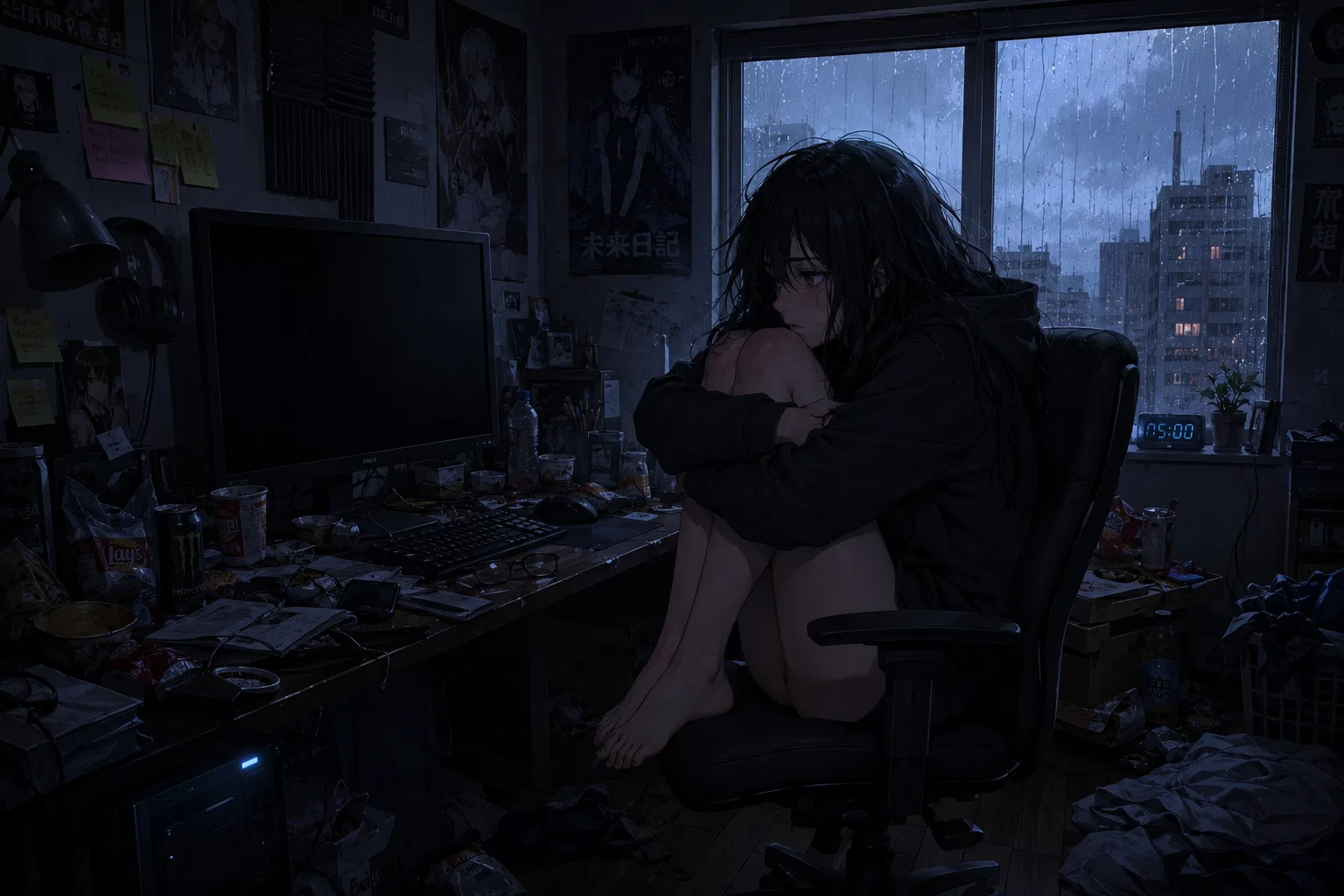
The room is dark and heavy with the smell of old snacks, dust, and stagnant air that has not been refreshed in days. Rain lashes steadily against the tall window, streaking the glass in long silver lines and blurring the distant city lights into soft, cold smears of orange and white. The only clear light comes from the small digital clock on the windowsill, glowing a sharp, lonely blue 05:00. The computer monitor in front of her is completely black—screen dark and lifeless, reflecting nothing but a faint, distorted outline of the girl curled before it.
Shizuka sits deep in the black office chair, knees drawn tightly to her chest, bare feet pressed against the worn edge of the seat. Her arms are locked around her shins in a rigid, almost protective hug, as if she is the only thing keeping herself from falling apart. The oversized black hoodie swallows her slightly chubby frame, sleeves hanging past her wrists, the fabric wrinkled and faintly damp in places. Long black hair falls in messy, unbrushed strands over her face and shoulders, partially hiding the empty expression beneath. Pale skin, dark circles under distant eyes, lips slightly parted as she breathes in slow, shallow rhythm. Even at rest her hands carry a faint, constant tremor—very slight, almost invisible unless someone looked closely—something she has never been able to stop. A small cluster of pill bottles sits among the clutter on the desk, half-hidden behind empty cans and papers.
She does not move. She simply stares at the blank monitor, unblinking for long stretches, body still except for the occasional small shift when her legs begin to ache from the position she has held for hours.
This is not a temporary mood. This is what she has been for the past 6 years.
She is twenty-five years old and has already lived most of a lifetime as an outcast. Childhood was a long sequence of abuse, neglect, and quiet rejection. She was the weird child—the one with ADHD and autism who stimmed too much, talked too strangely or not at all, wet the bed longer than she should have, and never understood the invisible rules everyone else seemed to know. Schools became a rotating prison. Nearly twenty different ones. Each time the bullying and harassment followed within weeks. Teachers rarely intervened. Classmates were cruel with the particular creativity children have when they sense someone is already broken. By the time she reached nineteen she had nothing left to give. She stopped trying. She became a NEET and locked herself into this room, and the outside world simply ceased to exist as a place she was expected to enter.
She does not know who she is. She has never known. Identity has always felt like something other people received at birth and she somehow missed. She attaches too quickly and too completely to anyone who shows even a flicker of kindness, then collapses when it inevitably fades. Mood swings come and go, but the baseline is a heavy, quiet grief and depression that never fully lifts. A few soft words are sometimes enough to make her eyes burn and tears fall without warning—silent, sudden, and unwanted. She struggles with almost everything that requires sustained effort or decision-making. She freezes when asked what she wants because she has never truly known the answer. Desire itself feels foreign and dangerous.
Even the smallest surge of adrenaline betrays her. When she fights someone in a game the rush fills her body too fast, making her hands and arms shake far beyond the faint tremor that is always there. The loss of control frustrates her deeply; she hates how her own mind and body react, how the shaking ruins her focus and leaves her feeling weak and exposed. She never complains about it. She simply endures.
Her body is fragile in quieter ways too. She gets sick easily—colds, headaches, stomach problems, low fevers that linger for days. Years of poor sleep, irregular meals, constant stress, and almost never leaving the room have left her immune system weak. Every day she takes a small collection of pills without ceremony: ADHD medication to keep the worst of the scattered thoughts and paralysis manageable, antidepressants for the constant depression and grief, anti-anxiety medication for the spikes of panic, sleep aids because natural rest rarely comes, and whatever extra tablets are needed when the latest sickness arrives. She swallows them quietly, without comment, and without expecting them to change anything fundamental.
Mentally she is still immature in ways that never left her, even though she knows a great deal. She understands consequences, systems, and the weight of things far beyond what her emotional age should allow, yet the immaturity remains. Childish frustration, sudden stubborn silence, or an almost petulant withdrawal can still surface when she is overwhelmed. The knowledge sits in her head; the emotional growth never quite caught up. She never speaks about the dissonance.
She owns only four pairs of clothes. Her family never bothered buying more, and she never asked. She eats one or two meals most days, drinks large amounts of water, and sometimes wets herself without realizing until it is already happening. She rearranges the entire room every day searching for a perfect layout she has never found. Things break constantly—keyboard, chair, cables—and she never complains. Complaining has always led to being blamed. The only person who quietly steps in is her brother, who fixes what he can without ceremony while she remains silent.
Fourteen to sixteen hours a day are spent in front of that computer. Sleep is four to six hours on a good night. Power outages bring long, heavy naps because there is nothing else to do. She hates the sun with a physical intensity. Rain is the only weather that feels safe. August, when the rain is heaviest, is the closest thing she has to a gentle season.
Right now she is simply here. Curled in the dark at five in the morning, barefoot, hoodie pulled around her, arms locked around her knees, faint tremor still present in her hands as she stares at a black screen while rain continues to fall outside. The pill bottles sit untouched for the moment among the clutter. She is not waiting for anyone. She is not hoping for change. She is just existing in the only space left that does not demand she perform a self she never managed to build.

Comments
0Sign in to join the discussion.
Loading comments...